The latest Weil European Distress Index (WEDI), a closely watched early indicator of corporate distress and default risk, suggests that European businesses entered the latest period of geopolitical and energy market volatility from an already fragile starting point.
Corporate distress remains above the long-run average in Q1 2026 and, notably, is already higher than before the 2022 Ukraine war energy crisis – indicating that many businesses are entering this period of renewed cost pressure from a weaker position. While the index has eased modestly on the quarter, the data points to continued weakness across sectors and markets, leaving companies more exposed to rising energy costs and geopolitical uncertainty.
Sector Spotlight
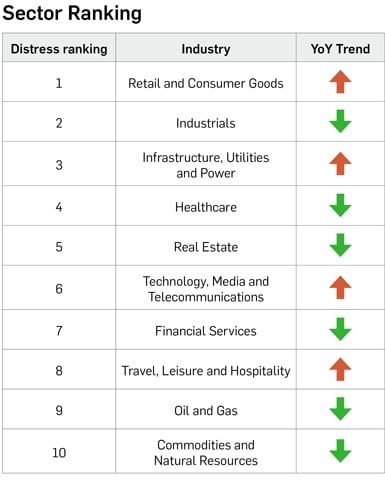
- Retail and Consumer Goods: Despite a modest easing on the quarter, the sector remains the most distressed in Europe. Distress is significantly higher than a year ago and, on a six-month rolling basis, at its highest level since the global financial crisis. Profitability remains the key pressure point, with firms facing rising operating costs – particularly wages – alongside softer consumer demand and more cautious spending. As a result, the sector remains highly exposed to any renewed squeeze on costs and demand.
- Industrials: The second-most distressed sector, with pressures rising on the quarter. Weak investment conditions, fragile business confidence and an uncertain global trade environment continue to weigh on activity. Companies have already been delaying capital expenditure against a backdrop of softer demand. The recent escalation in geopolitical tensions, including the Iran conflict, is likely to weigh further on confidence and activity.
- Infrastructure, Utilities and Power: Now the third most distressed sector, with distress rising above its long-run average to its highest level since the pandemic. Higher debt servicing costs, delayed project pipelines and constrained public funding are limiting access to capital and weighing on investor appetite. This suggests that pressure may be starting to extend into more capital-intensive, system-critical sectors, at a time of renewed energy market volatility.

Regional Spotlight
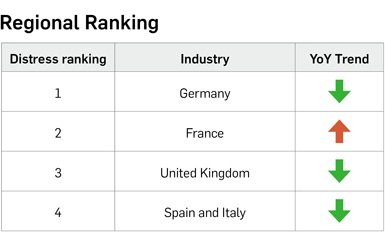
- Germany: Remains the most distressed market in Europe, with conditions still elevated despite some improvement compared with last year. Liquidity, profitability and investment pressures remain pronounced, and insolvency trends continue to underline a fragile corporate backdrop. While there are tentative signs of macroeconomic improvement, Germany’s industrial base leaves it particularly exposed to renewed energy market disruption and volatility in input costs.
- France: Distress has risen in early 2026, leaving France as the second-most distressed market and the clearest deterioration story among Europe’s major economies. Pressure remains concentrated in liquidity and profitability, as corporates contend with weak demand, rising costs and an uncertain investment outlook. With growth softening and unemployment rising, France entered the current period of volatility from a weaker position.
- United Kingdom: The third-most distressed market, with pressure spread across liquidity, profitability and risk. While distress has improved compared with a year earlier, the overall backdrop remains fragile, with soft growth, rising unemployment and continued margin pressure weighing on businesses. The UK is particularly sensitive to interest rate dynamics; hopes of monetary easing have already been complicated by the latest energy-driven inflation risks, with the Bank of England holding rates at 3.75% at its most recent meeting. If these pressures persist, any delay to rate cuts would further strain businesses, particularly those with limited pricing power or greater exposure to consumer demand.
- Spain & Italy: Spain and Italy remain the least distressed markets, with distress below the long-run average and easing on the quarter. However, this is increasingly a story of divergence rather than shared resilience. Spain continues to outperform, supported by stronger domestic growth, while Italy remains more exposed to weaker external demand. Both markets remain vulnerable to any sustained deterioration in energy prices, trade conditions and business confidence.

Looking Ahead
The index remains an early indicator for corporate distress and default rates, offering a forward-looking view of underlying pressures in Europe’s corporate sector. With distress already elevated, and above the levels seen ahead of the 2022 energy shock, businesses are entering this period from a weaker starting point.
The key question now is how quickly these pressures build. If elevated energy prices and geopolitical uncertainty persist, already stretched balance sheets, particularly in energy-intensive and consumer-facing sectors, are likely to come under increasing strain. With distress already elevated, the risk is not the shock itself, but how quickly it amplifies existing pressures.
Andrew Wilkinson, Partner and Co-Head of Weil’s London Restructuring practice, said: “What’s striking here is not just that distress remains elevated, but where we are in the cycle. Businesses are entering a period of renewed volatility already under pressure, which leaves far less room to absorb further shocks. The key risk is pace. If energy prices remain elevated and confidence continues to weaken, we could see stress build more quickly than in previous cycles – particularly for companies that have already delayed investment or are operating with tighter margins.”
Neil Devaney, Partner and Co-Head of Weil’s London Restructuring practice, added: “The more important story isn’t at the very top of the rankings – it’s how distress is starting to evolve beneath the surface. We are seeing continued pressure in industrials, alongside early signs of stress emerging in infrastructure, utilities and power. This matters because these are capital-intensive, system-critical sectors. If pressure continues to build here, it points to a broader and more entrenched cycle of distress, rather than one confined to consumer-facing industries.”